Research Foundation

The academic ground beneath the work

"Mind the Gap — or c'est le ton, qui fait the chanson: How do we establish equitable responsibility distribution in Global Production Networks and what role does technology play in this context?"

Institution
TU Munich · M.A. RESET
Submitted
January 2022
Word count
26,677
Companies interviewed
7 across 5 countries

What the research found

The question that started everything
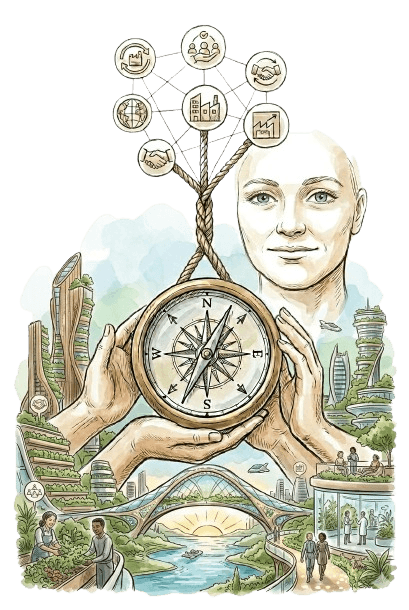
Global production networks involve dozens of companies across multiple countries — all of them making decisions that affect people and the planet. The brands at the top are increasingly held responsible for all of it. But responsibility that flows only downward, without capacity, support, or voice for the actors at the bottom, isn't responsibility. It's extraction wearing sustainability's clothes. This research asked: how do you build a production network where responsibility is genuinely shared — not just demanded? I interviewed seven companies contributing to a single fashion brand's production network individually, then brought them together in a joint workshop. What I found changed how I think about supply chains entirely. The most important finding: corporate responsibility and product responsibility must be treated separately. Every company in a global production network is an independent actor with its own constraints, capacities, and obligations. You can't govern product impact by treating suppliers as extensions of the brand. You have to talk with them — not about them. Technology matters, but it is a tool — not the solution. The digital infrastructure that's meant to enable transparency tends to reproduce the same power imbalances from the analogue world. Data without trust is just control at scale.

Four findings that shape my work today

Written in 2022. Still being confirmed in every client conversation four years later.

01

Everybody is doing their best

Every actor in the production network — brand, supplier, agent — was acting in good faith within the constraints of their position. Moral maturity wasn't the problem. Structural clarity was. This is why I don't look for bad actors. I look for broken systems.

02

Sustainability imperialism is real — and counterproductive

When brands push sustainability requirements onto suppliers without understanding their context, providing capacity building, or sharing the economic benefit — the result is paper compliance, not change. The approach that built the problem cannot fix it.

03

Separate corporate from product responsibility

Neither can govern the other's corporate decisions. A brand cannot dictate a supplier's internal management systems, governance, or wages. A supplier cannot tell a brand what to pay its own staff. Both are independent actors. What they share accountability for is the product — how it's made, under what conditions, with what materials. Current audit systems get this backwards: they demand corporate-level compliance while missing actual product-level accountability entirely.

04

Technology follows trust — not the other way around

Software implementations fail when the human system underneath them isn't ready. Trust, dialogue, and shared understanding have to come first. Technology is the infrastructure for what trust has already built — not a substitute for building it.

Research keywords

Equitable Responsibility DistributionGlobal Production NetworksSustainability ImperialismSupply Chain EthicsTechnology & TransparencyCorporate vs. Product ResponsibilityEthics of CareMulti-stakeholder DialogueFashion IndustryTU Munich · M.A. RESET

A note on where this comes from

The anchor point of this research is responsibility — and its distribution across global production networks. Its driver is an innate sense of justice. I used the first-person narrative throughout, because detached academic language felt dishonest for a topic this human. I want to state clearly: I did not write this research to evaluate or condemn the ways global actors have tried to assume responsibility. It is much more a reference point to uncover transformation potential. I want to critically examine existing approaches while remembering that those approaches brought us to where we are now. That is not nothing. It's a starting point. Four years later, working with companies on supply chain integrity, I find myself returning to these pages constantly. Not because they have all the answers — but because they ask the right questions.

Download the thesis

Read the full research

Enter your email and I'll send you the complete M.A. thesis as a PDF.

This form is protected by reCAPTCHA and the Google Privacy Policy and Terms of Service apply.